Physics reference: Λ⁰ → p π⁻
Last updated on 2026-07-14 | Edit this page
Reference for the decay reconstructed in this lesson.
The Λ⁰ baryon
The Λ⁰ is the lightest strange baryon (quark content uds, spin-parity ½⁺). With no lighter strange state to decay into strongly or electromagnetically, it decays weakly (strangeness-changing ΔS = 1). Weak decays are slow, so the Λ⁰ is long-lived on detector scales (cτ ≈ 7.9 cm) with a dominant two-body hadronic mode.
| Quantity | Value (PDG) |
|---|---|
| m(Λ⁰) | 1.115683 GeV |
| cτ(Λ⁰) | 7.89 cm |
| BR(Λ⁰ → p π⁻) | 63.9 % |
| m(p) | 0.9382720813 GeV |
| m(π±) | 0.13957061 GeV |
| Q-value | ≈ 37.8 MeV |
| natural width Γ = ħ/τ | ≈ 2.5 × 10⁻⁶ eV |
The charge conjugate Λ̄ → p̄ π⁺ is reconstructed
identically with the antiproton (PDG -2212) and π⁺
(211).
The V0 signature
Traveling ≈ 8 cm before decaying, the Λ⁰ produces a V0: two oppositely charged tracks from a vertex displaced from the primary interaction point. The neutral Λ⁰ leaves no track.
%%{init: {'theme':'base', 'themeVariables': {'fontSize':'15px','lineColor':'#94a3b8','edgeLabelBackground':'#e2e8f0','clusterBkg':'#1f293720','clusterBorder':'#94a3b8','titleColor':'#94a3b8'}}}%%
flowchart LR
    accTitle: {Lambda V0 decay topology}
    accDescr: {Lambda V0 decay topology}
    PV["primary vertex<br/>e + A collision"]:::vtx -. "Λ⁰: neutral, cτ ≈ 7.9 cm" .-> DV["displaced<br/>decay vertex"]:::vtx
    DV --> P["proton track (+)"]:::pos
    DV --> PI["pion track (−)"]:::neg
    classDef vtx fill:#e7efff,stroke:#4c6ef5,stroke-width:1.5px,color:#10204a;
    classDef pos fill:#ffe3e3,stroke:#e03131,stroke-width:1.5px,color:#5c0a0a;
    classDef neg fill:#e7f5ff,stroke:#1971c2,stroke-width:1.5px,color:#0a3d62;
This lesson skips the dedicated V0 finder and uses a simpler combination of particle identification and invariant mass, enough to expose a clear peak.
Observable: invariant mass
For a candidate proton p₁ = (E₁, p₁) and candidate pion p₂ = (E₂, p₂), the pair invariant mass is Lorentz invariant:
   E_i = sqrt(|p_i|^2 + m_i^2)            (m_i = assigned proton or pion mass)

   m(p, π) = sqrt( (E_1 + E_2)^2 − |p_1 + p_2|^2 )
Forming this for proton–π⁻ pairs produces:
- a peak at 1.115683 GeV from true Λ⁰ decays, and
- a smooth combinatorial background from pairs with no common parent.
Width is resolution, not lifetime
The natural width (Γ ≈ 2.5 × 10⁻⁶ eV) is negligible next to any instrumental effect. The observed peak width — a few MeV — measures detector momentum and angular resolution, not an intrinsic Λ⁰ property.
Signal extraction
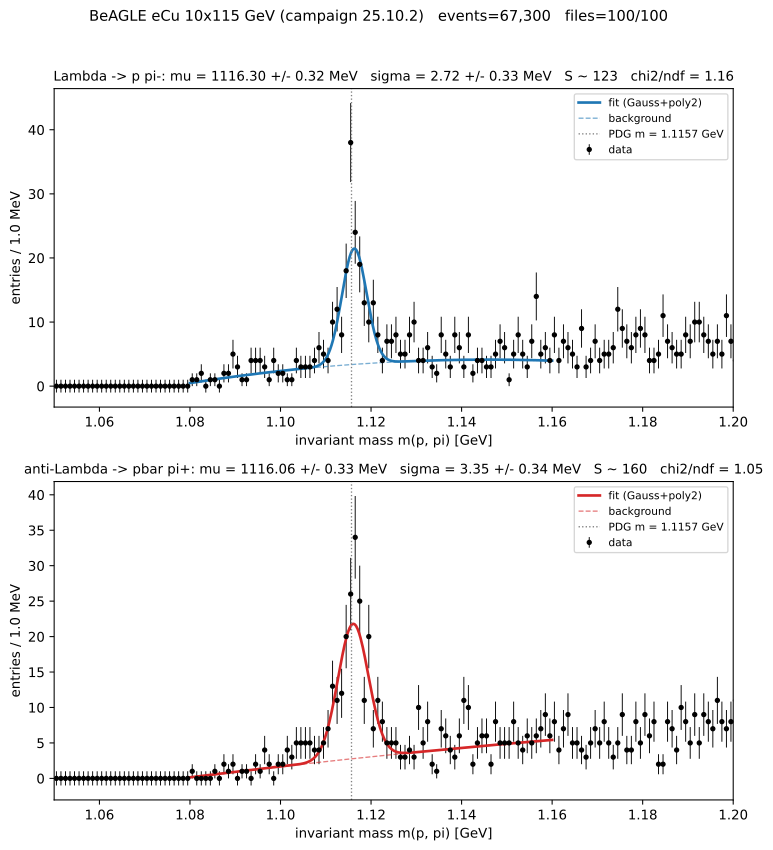
Fit a Gaussian signal on a second-order polynomial background over a window centered on the peak:
f(m) = A · exp( −½ ((m − μ)/σ)^2 ) + ( c0 + c1 (m − m_Λ) + c2 (m − m_Λ)^2 )The fitted μ should lie within a few MeV of 1.115683 GeV (a residual
offset reflects momentum calibration), σ measures the mass resolution,
and the integrated signal is \(S =
A\sqrt{2\pi}\,\sigma / (\text{bin width})\). Build the proton–π⁻
mass spectrum by asking opencode to
run the uproot execute_kernel_dataset tool (tree
events, with the proton and pion branches) across the
dataset’s root:// files, then fit it with the form above.
Reference result below: μ ≈ 1.1163 GeV, σ ≈ 2.7 MeV, χ²/ndf ≈ 1.2.