
Introduction
Last updated on 2026-07-11 | Edit this page
Overview
Questions
- Why should I be interested in track-cluster matching?
Objectives
- Understand physical motivation behind examples in tutorial
Like we noted in the Setup section, our goal in this tutorial is to understand how to use the PODIO interface in an analysis. As such, this tutorial will build on the earlier Analysis Tutorial, which discussed how to analyze our reconstruction output with the ROOT TTreeReader and RDataFrame.
Our vehicle for doing so will be two commmon and complementary analysis routines:
- Matching tracks and clusters; and
- Matching truth objects to their reconstructed counterparts.
On one hand, the former utilizes purely reconstructed objects (tracks and clusters) and will illustrate the basics of PODIO. While on the other hand, the latter utilizes purely simulated objects (generated particles) and will illustrate how to navigate relations and associations.
We’ll deploy these routines to study \(J/\psi\) decaying to \(e^{+} + e^{-}\) pairs, a common decay channel used in many areas of EIC science.
Why these?
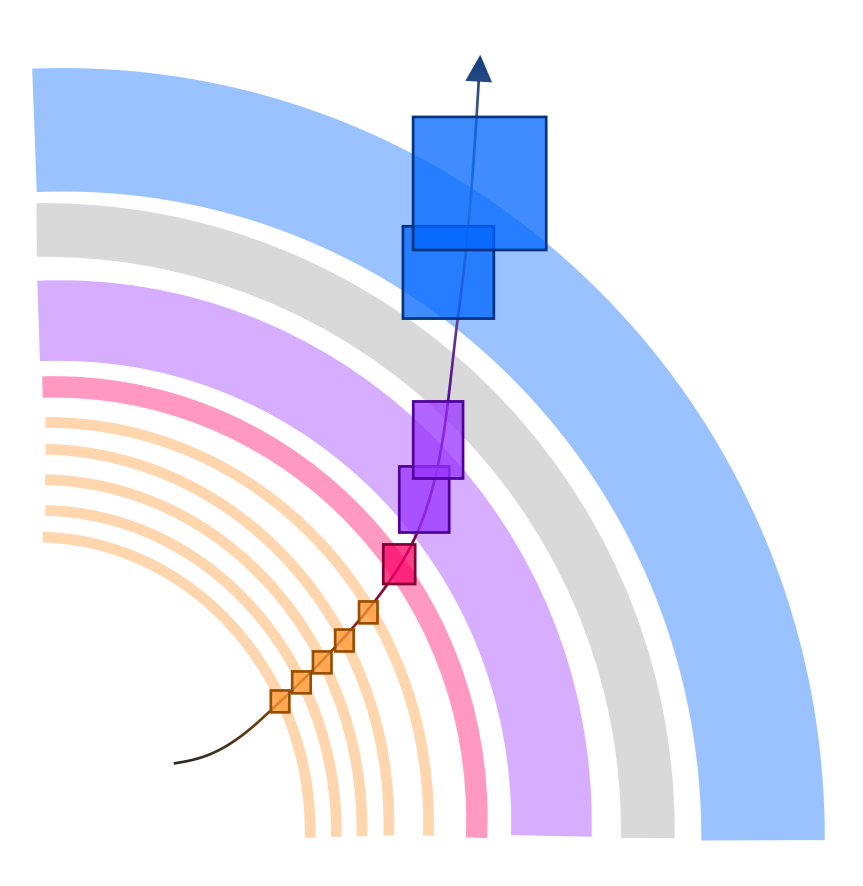
Before diving into PODIO, though, I would like to motivate why you should care about these two routines. To start, remember that a particle is not just a track, a cluster, or so on. A particle will leave signals in several detectors. The majority of particles in a typical DIS event will create hits in our trackers and will shower — forming a cluster — in at least one of our calorimeters.
This is illustrated in the following image, where the colored bands indicate the tracking layers (orange), cherenkov detector (pink), electromagnetic calorimeter (ECal, purple), magnet solenoid (grey), and hadronic calorimeter (HCal, blue) in ePIC’s barrel.
Accurately reconstructing the particle — its momentum, energy, charge, mass — will require us to make use of all of this information. For example, an electron will create a track and will usually deposit all of its energy into an ECal. In contrast, a charged hadron like a \(\pi^{-}\)), will frequently deposit energy into HCal, while a \(\pi^{0}\) will deposit energy into an ECal without creating a track. This is illustrated in the following figure.
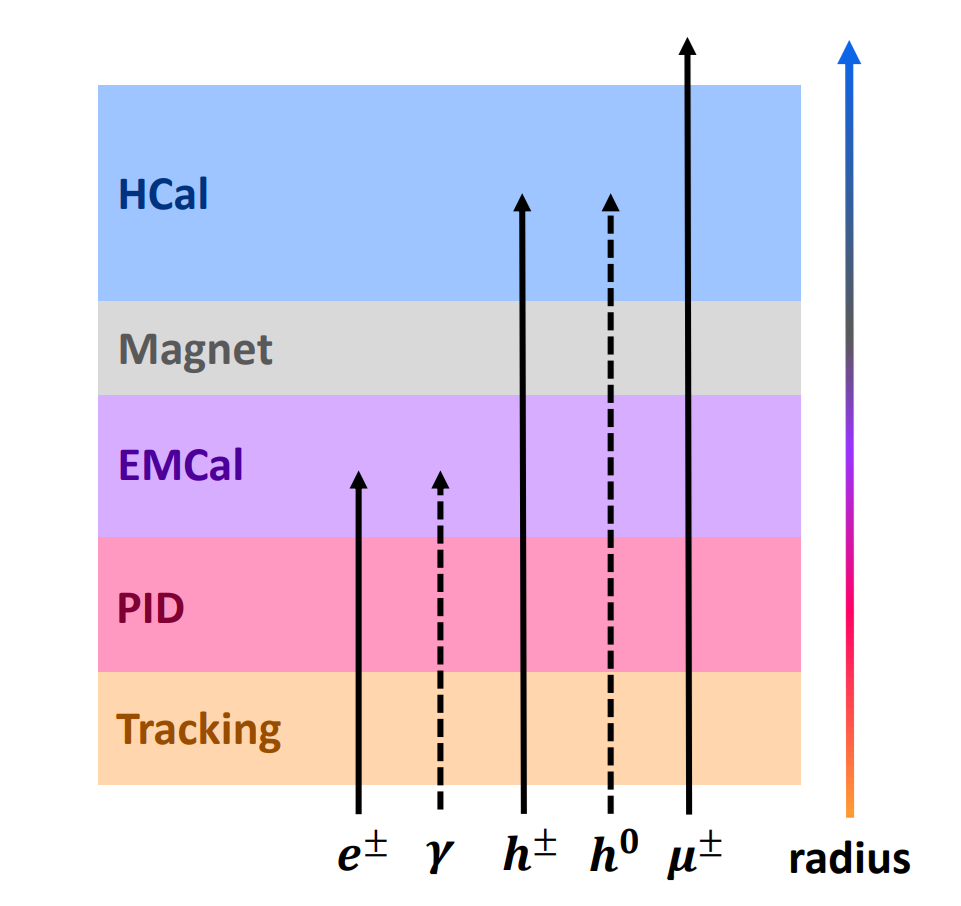
Therefore, track-cluster matching is a critical step in our reconstruction, which we use to identify leptons, measure neutral particles, and more. In this tutorial, we’ll use it identify decay \(e^{\pm}\) which we’ll reconstruct a \(J/\psi\) from.
To validate our reconstructed \(J/\psi\), however, we’ll need to identify the corresponding simulated particles and compare them. That’s where the truth-reco matching comes in.
References
- Track-cluster is a critical part of reconstructing particles
- Truth-reconstructed matching is needed to validate reconstructed particles